Why Micro Four Thirds
Table of Contents
A Decision
I have waffled on what my preferred camera is for many years now. In doing so, I developed a bad habit of buying and selling camera gear on a nearly monthly basis. This wasn’t just bad for my wallet, it was starting to wear on my mental health, too. So, when we recently came into some extra cash–and after paying off some debt–I decided it was time to dive into a system that I will stick to in the long run. This required no small amount of research and reflection, which meant I spent some time looking over my photo library and being honest with myself about what I needed and wanted from a camera.
How did we get here?
When I started with photography, I was shooting on an old HP point-and-shoot camera with a terrible sensor, terrible lens, and very little in creative controls. But I took that camera with me everywhere. It got me hooked on taking photos. By the time I was graduating high school, I had purchased my first DSLR, the Canon T1i. I immediately sold the kit 18-55 and purchased the Canon 50mm II, and I used that lens for everything. I learned to love shooting with that fixed focal length and relatively small kit.
At the same time, I inherited a Canon AE-1 from my grandfather, along with the 50mm f/1.8, and I’ve put a lot of rolls through that camera over the years. I love the look and feel of that camera and started avoiding picking up the bulky, boring DSLR over time. That change led me to looking at smaller, mirrorless cameras that offer a balance between what digital and film offer. That’s when I found Fujifilm.
Becoming a Fuji Guy
Back in 2023, I wrote about my journey to, away from, and back to Fujifilm. I really thought I would stick with that in the long run. I’ve loved every Fuji camera I’ve used and I think, if you’re in the market for something with that film camera feel, there’s no better system.
But, the camera had other plans. Whoever owned that camera before me must have loved it… While it looked almost brand new on the surface, the rear thumb grip, dials, and buttons were all never quite right. And, eventually, I got fed up with trying to change settings and them not, well… changing.
Since then, I’ve been bouncing between a few cameras. The first, the Olympus E-M5 II, I thought I would stick with longer, but when my budget shifted I sold it and went to the Nikon D7000. The D7000 is a fantastic camera for the money and Nikon DSLR lenses are cheap. Great for getting into more “serious” photography on a tight budget. All in all, I’m actually pretty happy with the Nikon setup. I also got the Olympus E-M10, since the Olympus 75-300 II is still probably the cheapest way to get to a 600mm full frame equivalent focal length. So… Why am I changing again?
What’s changed?
Recently, we came into a bit of money after selling our house, and while I can afford to I thought it was finally time to commit. This meant really thinking about what I wanted in a camera system and researching what would fit the bill. I also wanted to get something fairly new, so I wouldn’t feel that pull to “upgrade” too quickly. And, despite its tradeoffs, that led me back to Micro Four Thirds.
So, Why (Or Why Not) Micro Four Thirds?
Micro Four Thirds is an interesting system. It was introduced in 2009 and promised DSLR-level image quality in a point-and-shoot package. But, the reality is… Complicated. Micro Four Thirds certainly does provide image quality far superior to smartphones and point-and-shoot cameras, but it usually falls short of even entry-level APS-C camera sensors. In terms of size and weight, it may have provided a big advantage at the time, but full frame mirrorless cameras could be had at nearly the same size by the time the Sony A7 came out in 2013.
The other advantages MFT1 provides have largely become less pronounced, as well. The cost of full frame gear has come down dramatically, and APS-C is often cheaper. The image quality gap has widened as new sensor tech benefits even further on larger sensors. Even lenses have gotten smaller and lighter, and new full frame and APS-C cameras have very competitive IBIS2.
The last hiccup for me is DoF3. As someone who loves bokeh balls and creamy backgrounds, I really did have a hard time accepting that particular tradeoff. But, I know that as long as I’m not comparing my photos side-by-side with images from bigger sensors, it probably won’t matter.
Boy, this system sure is sounding less and less impressive! So, why am I still choosing it?
Size & Weight
Despite the shrinking advantage MFT has in size and weight, it still does have one. Particularly when looking at zoom and long lenses, MFT lenses are considerably smaller and lighter than even their APS-C counterparts. As someone who is becoming increasingly interested in birding, the ability to get the full frame equivalent of 600mm in a lens the size of a beer can is pretty awesome. And, if I ever upgrade to something faster or longer down the road, I know I’m not signing up for carrying around something the size and weight of my own thigh.
However, if you’re someone who almost exclusively shoots between 35-85mm with prime lenses? I really can’t recommend anything but full frame in 2026. A small full frame body with two to three small, fast prime lenses make for a great kit without being much bigger or heavier.
Cost to Performance Ratio
This was important to me. I’m a hobbyist and make exactly zero dollars on my photography each year. So, while I could have spent a decent amount on enthusiast-level gear, I wanted to be honest with myself. The fact is that, for the price, MFT provides a great balance of price to performance. What I mean is, you can get a fast camera with lots of features and great image quality, plus fantastic lenses, for not a ton of money. Yes, there are cameras at similar price points that exceed the capabilities of MFT cameras on almost all fronts, but I can almost guarantee you can’t do the same with lenses. Especially when you consider my next point.
But, first, a quick note about image quality. Let me be clear: Outside of side-by-side testing with bigger, more expensive cameras, I have never been disappointed by the image quality of my MFT cameras! My all-time favorite camera, the Olympus E-M5 II, with its tiny 16mp sensor and “poor” dynamic range, has captured some of my favorite photos throughout the years.
Weather Resistance
I thought, in 2023 when I picked up that X-T20, that weather resistance was a luxury that I didn’t need to afford. But, since then, I’ve been out many times where I was either so happy to have weather sealed gear, or wished that I did have weather sealed gear. So, when it came time to choose a system, I knew I should make reliable weather sealing a priority. And, when it comes to weather sealed camera gear, no one is doing better than Olympus/OM System. They are one of the (if not the only?) camera companies putting an actual rating on their weather sealed gear. That’s pretty cool!
Reach
I mentioned earlier that I am getting into birding, and one spec is more important than any other when it comes to photograhing small birds: reach. You could debate that technique matters more, that getting closer to the birds matters more (‘cus, ya know, they don’t deserve to not be disturbed for my photos), or that having a high resolution sensor matters more. But, at the end of the day, the goal is pretty much the same: Get the most number of pixels on the bird. With MFT, you can do this while carrying much smaller and lighter lenses, and as a hobbyist I’m really not keen on carrying around 5lbs of glass worth $2,000+. Yes, you might sacrifice some low-light performance or subject seperation, but again… Zero dollars per year earned.
Fun Factor
If you don’t want to use your gear, you won’t, or at least not as often. And MFT cameras are fun! They feel agile, flexible, and fast. They come with cool features like high-res shot, Live ND, and great autofocus. Plus, the Olympus/OM System cameras have a very similar vintage-inspired look and feel to Fuji cameras. They look very handsome and feel great to use. These are cameras I want to pick up and shoot with.
What I Got
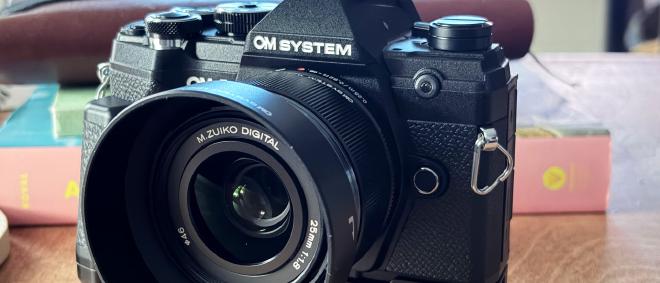
So, as you’ve probably guessed, I got an Olympus/OM System camera. But which one? Well, at the time of writing this B&H has the OM System OM-5 new for $750 USD. Not bad! Less than you’d typically find that camera used, so I jumped at the opportunity!
Along with the body, I also got a couple of extra batteries, a grip for better handling, and two lenses: the 25mm f/1.8 II and the 12-45mm f/4 Pro (both purchased used). I also already had the 75-300mm II, which I’ve had decent results with on my E-M10.
With this, I have a small, light kit that will cover 99% of what I’d typically shoot in a year. And, I’m sure my library of lenses will only grow.
Conclusion
I know I didn’t need to justify my choice to anyone, but maybe… I needed to justify it to myself? I flip-flopped a lot between going all-in on MFT or full frame, and even considered using both!
I also think, in a world where even the most casual hobbyists are switching to big, expensive full frame cameras, it’s nice to highlight the little guys.
But, what do you think? Is Micro Four Thirds worth the tradeoffs, or not?
-
Micro Four Thirds. I’ll refer to the system as MFT from here on out. ↩︎
-
In-Body Image Stabalization is a great technology, but not perfect. I wouldn’t make it a priority unless you mostly shoot at night, handheld, or take lots of videos. ↩︎
-
Depth of Field - How much stuff is in focus from the camera outward. ↩︎